She's 9 Years Old and I Thought I'd Never See Her Run Again. I Was Wrong.
I had quietly accepted that my cat's playful days were behind her. Then I learned something about how cats actually work, and everything changed.
About this article
Most cat owners with older cats have made peace with the idea that the playful years are just gone. This article explains why that's not true, what's actually causing the disengagement, and what finally worked for one cat mom who had tried everything.
Date:
Author:
Sarah M.
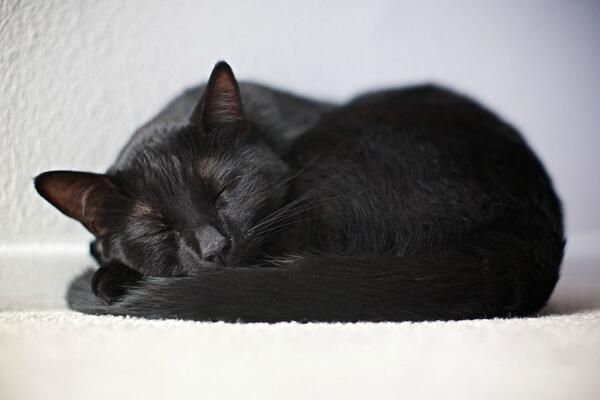
For two years, Maple barely moved.
She'd eat, find a patch of sunlight, and sleep. That was her day. I told myself it was normal and that she was getting older. Cats slow down. The vet said she was fine. I repeated those things enough times that I almost believed them.
But there was this moment about six months ago, where I watched her sitting at the window just staring outside. Something about the way she looked made me feel like I had failed her. Not in a dramatic way, but like I had let something important slip away and convinced myself it didn't matter.
I started reading everything I could find about indoor cat behavior. That's when I came across something that I genuinely couldn't stop thinking about.
Cats are hardwired to complete a four-stage sequence every time they hunt: search, stalk, pounce, catch. In the wild, this loop runs multiple times a day. It's how a cat's nervous system stays calibrated. It's what makes them feel like themselves.
Indoor life breaks that loop entirely. There's nothing to search, stalk or fight. Most cat toys only trigger one or two stages of that sequence before the cat's brain recognizes it isn't real and completely switches off.
That's not laziness. That's an incomplete loop running over and over with nowhere to go.
I started looking at every toy I'd ever bought Maple through that lens. The feather wand, stalk only. The electronic mouse, pounce, but no catch. The catnip banana she sniffed once and never touched again. None of them completed the sequence. Not one.
So I started looking for something that did.
"I hadn't seen her move like that in years. She played for twenty minutes straight and then curled up right in the middle of it and fell asleep. I texted my sister a video and I was shaking a little. I didn't realize how much I missed it until it came back."
Sarah M.
Cat mom of Maple (age 9)
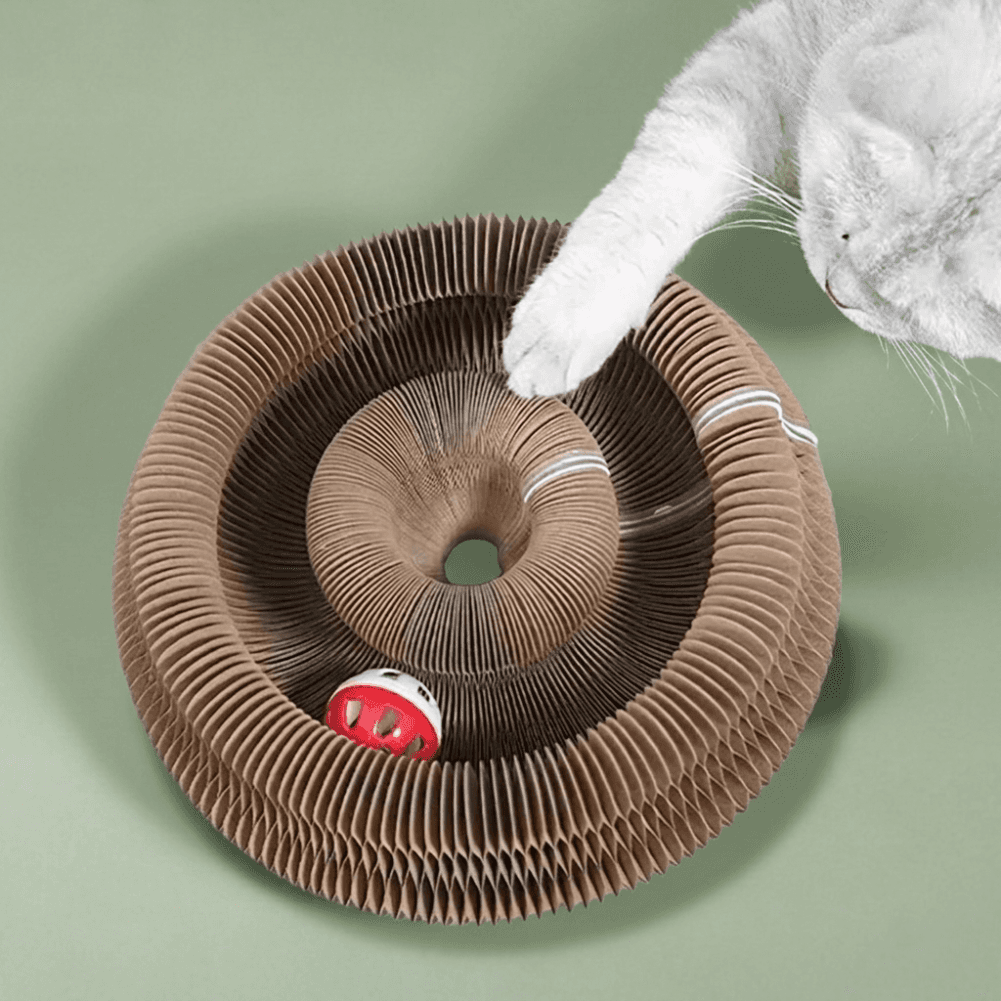
The foldable organ scratcher was the first thing I found that was actually designed around all four stages.
The accordion shape shifts every time she touches it. It compresses, springs back, changes form. From her perspective it never fully reveals itself, which means her brain never gets the signal that the hunt is over. The bell ball inside the track moves unpredictably. She can hear it but she can't see it, which forces the search phase to activate every single session. The corrugated cardboard gives her something to dig into creating tactile resistance that completes the catch.
The first time I put it down, she walked over without any coaxing and just started. No catnip. No waving it in her face. She played for twenty minutes, took a break, and came back.
I stood there watching her and felt something I hadn't felt in a long time about being her owner.
If your cat is slowing down and you've been quietly making peace with it, I want you to know I understand that feeling. And I want you to know it might not be as permanent as it looks.
It's not too late to bring the playful cat back. And the risk of trying is about as low as it gets — it ships with a buy one get one free offer and a 30-day money-back guarantee. If your cat ignores it completely, you pay nothing.
Maple is nine years old. She runs now.
You might be wrong too.